
-
 Technology Portfolio
Versigent draws on the most innovative and optimized technologies to create a full range of advanced power, signal and data distribution systems.
Technology Portfolio
Versigent draws on the most innovative and optimized technologies to create a full range of advanced power, signal and data distribution systems. -
Signal & Data
Signal and data network technologies connect key systems, handling everything from simple control signals to large data flows.
-
Power
Regardless of powertrain, today’s vehicles rely on extensive power distribution capabilities to function.
-
Working With Us
With Versigent, our customers get a partner that deeply understands their design and execution needs.
-
Design
Versigent has the boldness, creativity and versatility to design innovative and unexpected solutions for your most complex requirements
-
Execution
Versigent excels at manufacturing efficiency, automation and execution. It’s an integral part of everything we do.
-
About
Versigent is a global leader in intelligent electrical architectures, delivering solutions at speed with a legacy of innovation and expertise.
-
Senior Leadership
Versigent’s senior leadership team brings deep industry expertise and a focus on innovation to drive solutions at speed.
-
Investors
Visit Versigent’s Investor Relations Site.
-
Sustainability
We deliver solutions of the highest quality and reliability – designed, developed and manufactured responsibly – that transform society.
-
Technology Portfolio
Versigent draws on the most innovative and optimized technologies to create a full range of advanced power, signal and data distribution systems.
-
Signal & Data
Signal and data network technologies connect key systems, handling everything from simple control signals to large data flows.
-
Power
Regardless of powertrain, today’s vehicles rely on extensive power distribution capabilities to function.
-
Working With Us
With Versigent, our customers get a partner that deeply understands their design and execution needs.
-
Design
Versigent has the boldness, creativity and versatility to design innovative and unexpected solutions for your most complex requirements
-
Execution
Versigent excels at manufacturing efficiency, automation and execution. It’s an integral part of everything we do.
-
About
Versigent is a global leader in intelligent electrical architectures, delivering solutions at speed with a legacy of innovation and expertise.
-
Senior Leadership
Versigent’s senior leadership team brings deep industry expertise and a focus on innovation to drive solutions at speed.
-
Investors
Visit Versigent’s Investor Relations Site.
-
Sustainability
We deliver solutions of the highest quality and reliability – designed, developed and manufactured responsibly – that transform society.
EVs are gaining popularity all over the world, and EV charging is developing differently for different regions and use cases. This makes for a high degree of complexity — and a lot of part numbers — for global OEMs. But there are three generally accepted descriptors for electric vehicle supply equipment (EVSE), which includes EV chargers: mode, level and type.
Mode: The mode reflects how the EVSE connects to the electrical grid.
- Mode 1 plugs into a household AC socket, but it generally is not permitted in most regions, because Mode 1 lacks special safety electronics.
- Mode 2 also plugs into a standard household AC outlet and includes those safety features in its in-cable control box (ICCB).
- Mode 3 plugs into a wall box or charging station for an AC charge. It does not include an ICCB. Consumers are often required to bring their own Mode 3 cable to use public AC charging stations in Europe.
- Mode 4 is reserved for high-speed DC charging at charging stations.
Level: The level indicates how much electric power is delivered to the vehicle. The Society of Automotive Engineers specifies the following levels in the J1772 standard:
- Level 1 is limited to 120V and 1.8 kW and delivers basic charging.
- Level 2 is defined as 208V to 240V and up to 80A, with a maximum output of 19.2 kW. As OEMs increase battery sizes, they are also increasing the power level within this band. Typical BEVs today can take 11 kW of AC power via their onboard chargers. Homes with three-phase power installed can reach 11 kW with 16A of current, while a single-phase power source would need to supply about 48A.
- DC Level 1 and 2 provide fast charging and are only available at commercial stations. DC Level 2, commonly referred to as simply “Level 3,” can provide up to 1,000 VDC and is projected to reach 500A in the future, with a power output of more than 350 kW. This rate can charge about 80 percent of a typical EV battery in as little as 20 minutes.
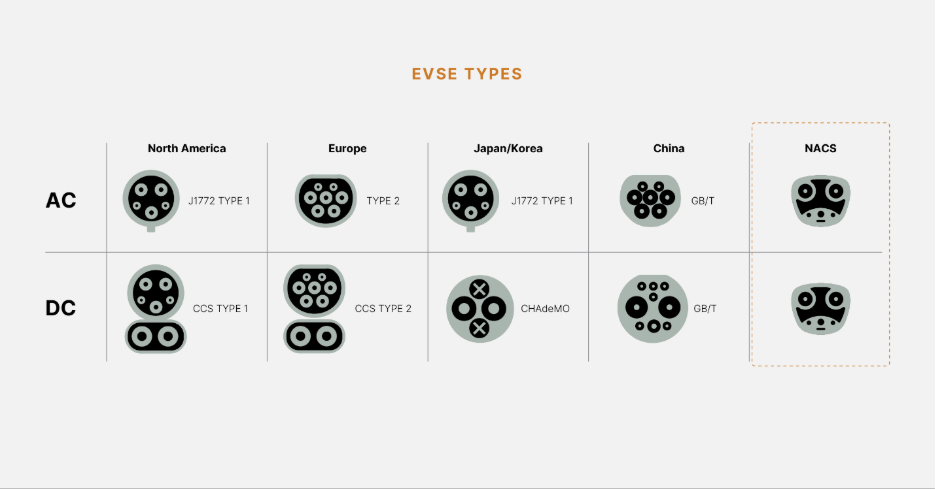
Type: Type refers to the vehicle interface. Unfortunately, standards organizations have not aligned behind a global standard. Consequently, there are several unique interfaces for AC charging globally:
- North America and Korea use J1772 Type 1 for AC and CCS1 for DC.
- Europe uses IEC Type 2 for AC and CCS2 for DC.
- Japan uses J1772 Type 1 for AC but CHAdeMO for DC.
- China uses the GB/T interface for AC and a unique DC interface.
- In addition, the ChaoJi-1 standard is approved in China and in development in Japan.
- The North American Charging Standard (NACS) is on its way to becoming a formal standard.

Working With Versigent
Our customers get a partner that deeply understands their design and execution needs.
Careers
Our strength is our people, driven by a passion for quality, reliability and engineering excellence.
View Related Jobs